PROJECT SUMMARY
Mental health and substance use are deeply intertwined. For millions of Canadians, one leads to the other. But on Canada.ca, they lived in completely separate sections. Scattered, buried, and hard to navigate... even when you weren't in need of such resources. Health Canada brought in my team and I to lead the research. I was the UX research lead, responsible for strategy, research materials, facilitation, IA development, and synthesis.
Client:
Health Canada
Timeline:
9 Weeks · 2024
My Role:
Lead UX Researcher
SCALE OF THE PROJECT
96+
Total participants across all phases
26
Moderated 1:1 sessions
6
Research methods used
2
Languages - English & French
METHODOLOGY
01. Heuristic Analysis
*I led this*
We conducted an expert review of the “Mental Health and Wellness” and “Substance Use” sections of the Health Canada website using Nielsen Norman Group’s 10 heuristic principles.
Three UX researchers independently scored the content from ‘zero’ (critical issue) to ‘four’ (no issue), identifying key usability challenges and forming hypotheses to guide further research.
02. Comparative Analysis
We reviewed five websites from public and private sectors to explore how similar platforms address users’ needs. We looked at:
This helped identify successful patterns and areas for improvement.
03. Website Analytics
*I led this*
I analyzed a full year (2023) of Adobe Analytics data for the Mental Health and Substance Use sections of the Health Canada website.
This provided insights into user behavior, navigation patterns, and engagement trends.
04. User Surveys
*I led this*
I thoughtfully designed a trauma-informed survey and hosted it on the Health Canada website to collect quantitative data on user needs, preferences, and pain points.
This survey was also used to recruit participants for usability testing exercises that followed.
05. Baseline Usability Testing
*I led this*
18 remote 1:1 sessions, 10 tasks, on the live site
The goal was to understand audience needs, assess existing content strengths and weaknesses, and establish a usability benchmark for proposed improvements.
06. Information Architecture & Treejack Testing
We reworked the site’s Information Architecture (IA) based on insights from earlier research, collaboratively developing a revised IA with the client team.
70 participants validated the new IA with labels only, no visual design. We measured how well the new IA aligned with user expectations and identified areas for label improvements.
07. Rapid Prototyping
A polished version of the final IA was rapidly prototyped in Figma, following the GC (Government of Canada) Design Systems.
08. Validation Usability Testing
*I led this*
8 sessions to test the prototype and compare directly to Round 1 baseline results
This validated the impact of the research-informed changes and led to a final iteration of the IA.
THE BEFORE
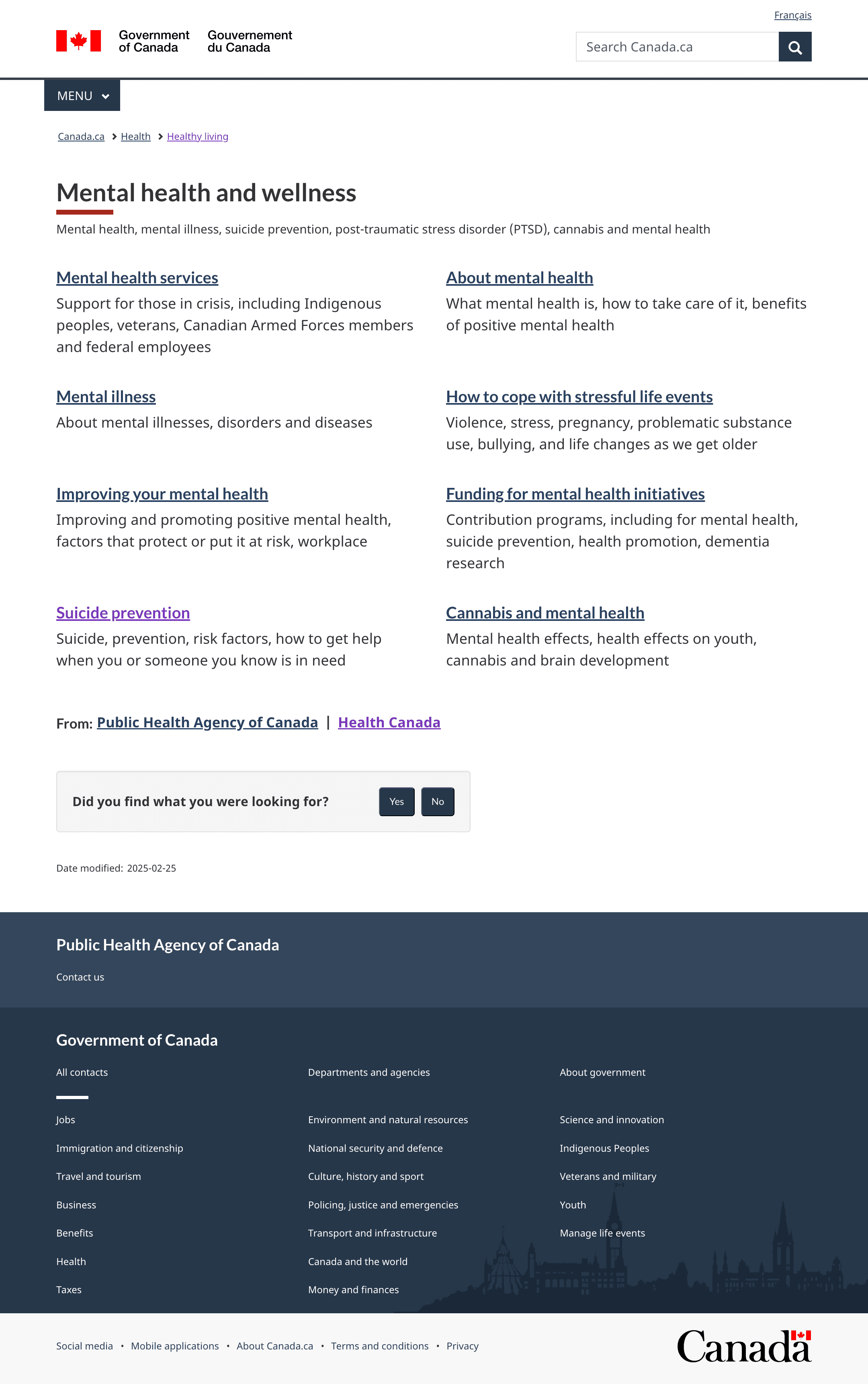
Mental health section
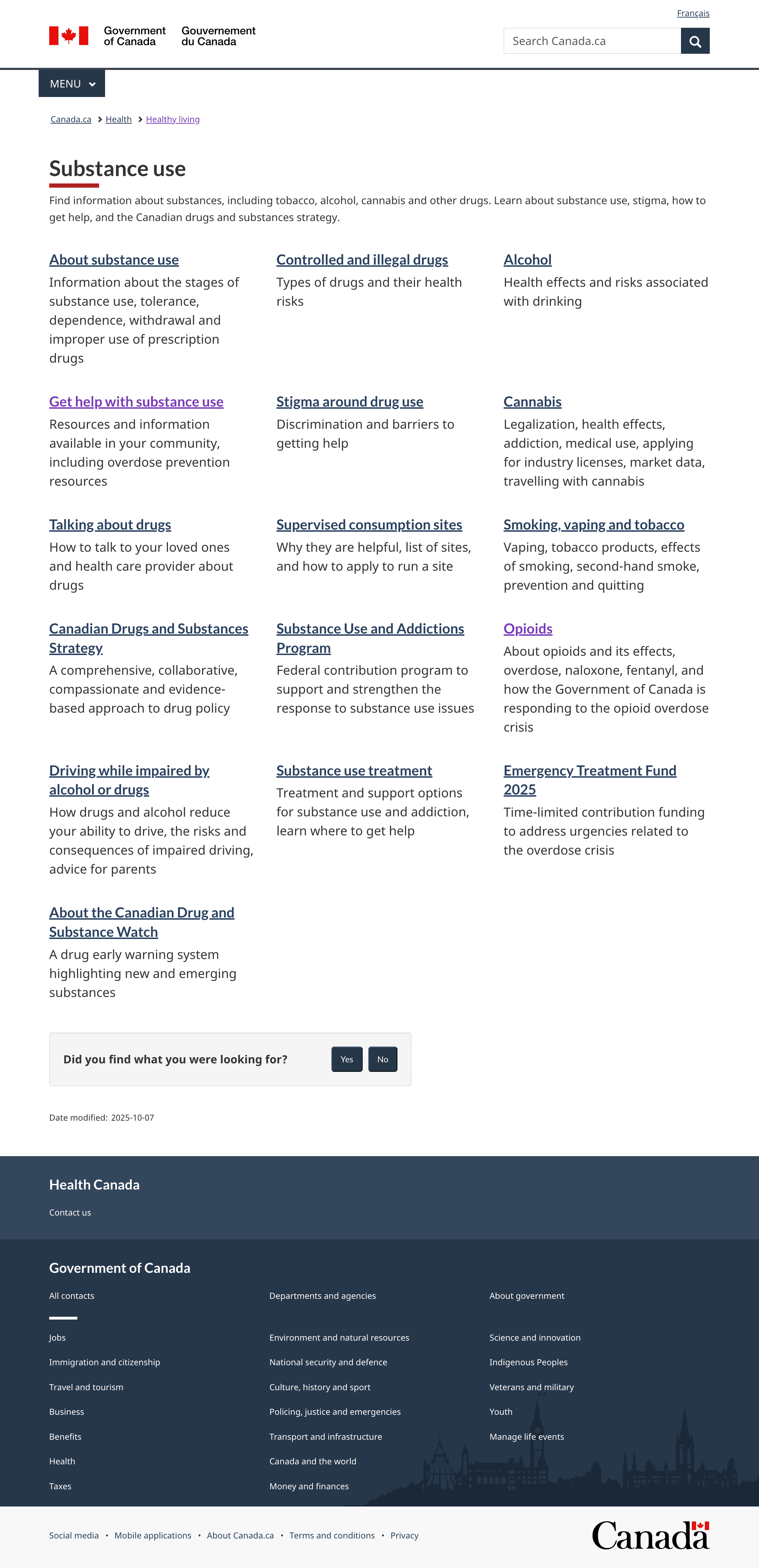
Substance use section
KEY FINDINGS
People navigate by situation, not by category
Users think in moments. "My relative is drinking and seems depressed, where do I go?"... not in government content hierarchies. This mismatch was the root of most task failures.
Critical resources were buried
The 9-8-8 crisis helpline existed on the site, but required 3-4 navigation steps to reach. Only 13% of Treejack participants could find local support services... because the term "local" appeared nowhere in the navigation.
The "official" tone created distance
Multiple participants described the site as intimidating and "too official." When a resource feels cold and institutional, it amplifies the stigma that makes people hesitant to seek help in the first place.
The two topics existed in silos
Only 4 of 18 participants noticed the topics weren't integrated. But when asked directly, 14 of 18 said integration would be valuable. After the redesign, all 8 validation participants confirmed it felt more connected.
Trust was there, discoverability wasn't
Participants generally trusted Health Canada. The problem wasn't credibility, it was that they couldn't find what they needed, and often went to CAMH or Reddit instead.
WHAT WE REDESIGNED
BEFORE
Healthy Living
Mental health and wellness
Mental health services
Suicide prevention
About mental health
Substance use
About substance use
Cannabis
Opioids
Get help with substance use
AFTER
Mental Health, Substance Use and Support [NEW]
Crisis Resources [Elevated]
9-8-8 Suicide Crisis Helpline
Overdose Resources [NEW]
Crisis Chat Options
Mental Health Awareness
Substance Use
The relationship between MH & SU [NEW]
Services for Treatment & Recovery [RENAMED]
Staying Informed

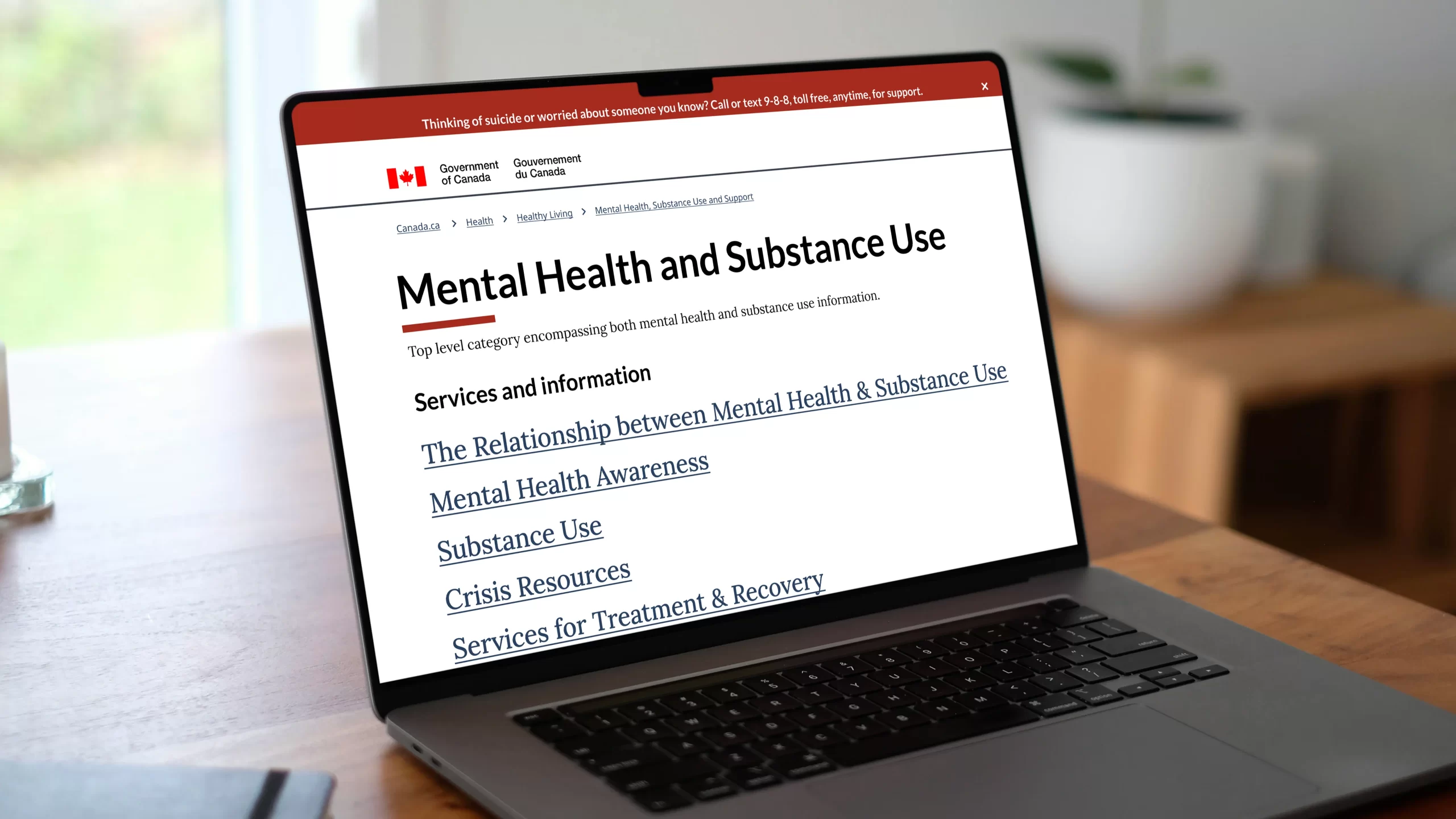
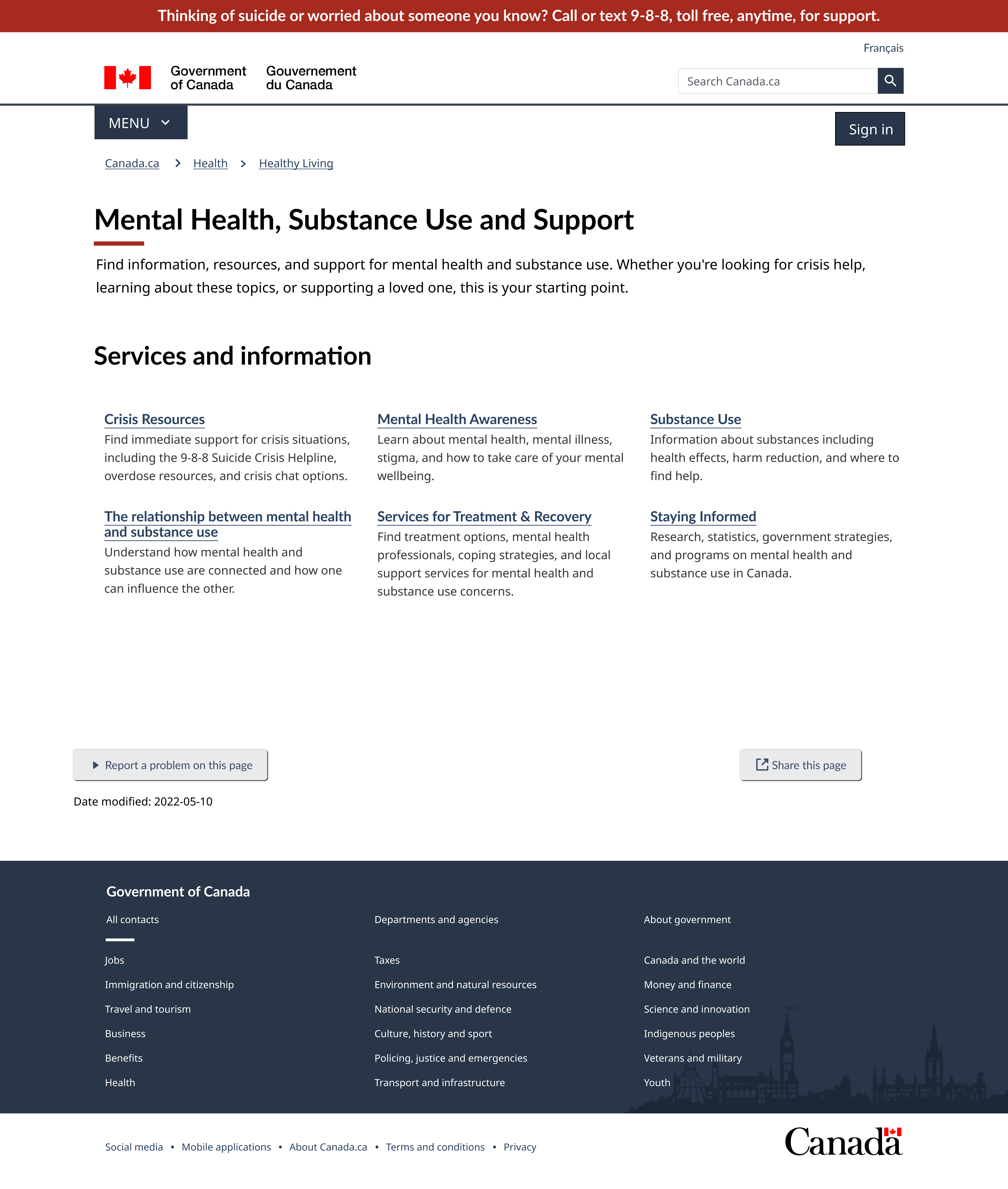
The red bar at the top is new. It follows users across every page in the section, so no matter where someone lands, crisis help is always one glance away.
In validation testing, 6 out of 8 participants noticed it immediately without being prompted.
This replaced two separate pages… "Mental health and wellness" and "Substance use", that had no clear connection to each other.
The new homepage brings everything under one roof, with six clear entry points so users can find what they need without knowing which "category" their problem belongs to.
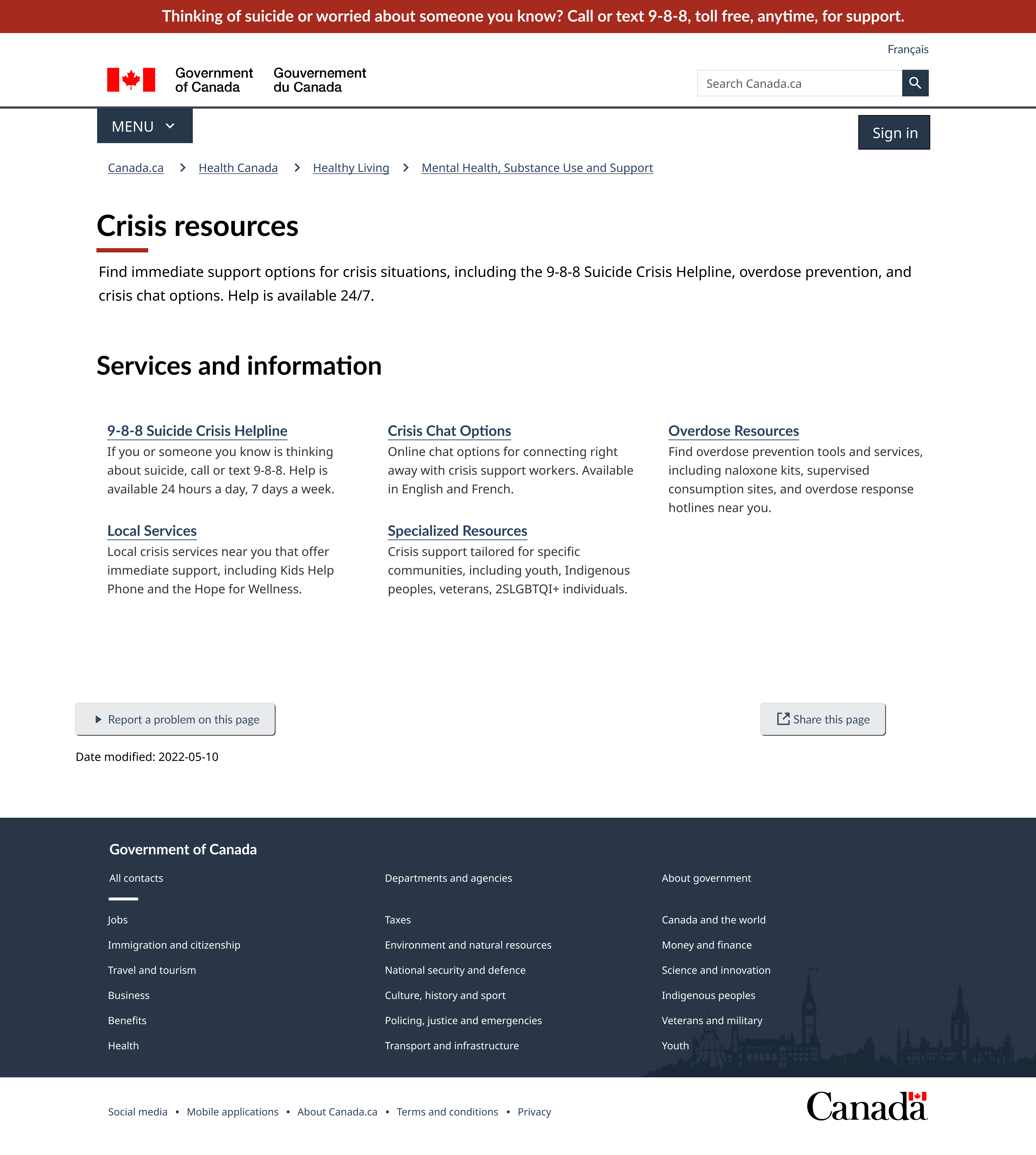
Crisis support used to live several clicks deep inside the site. Now it has its own top-level section. The word "immediate" in the description was deliberate. Treejack testing showed it significantly helped users identify this as the right place to go in an urgent situation.
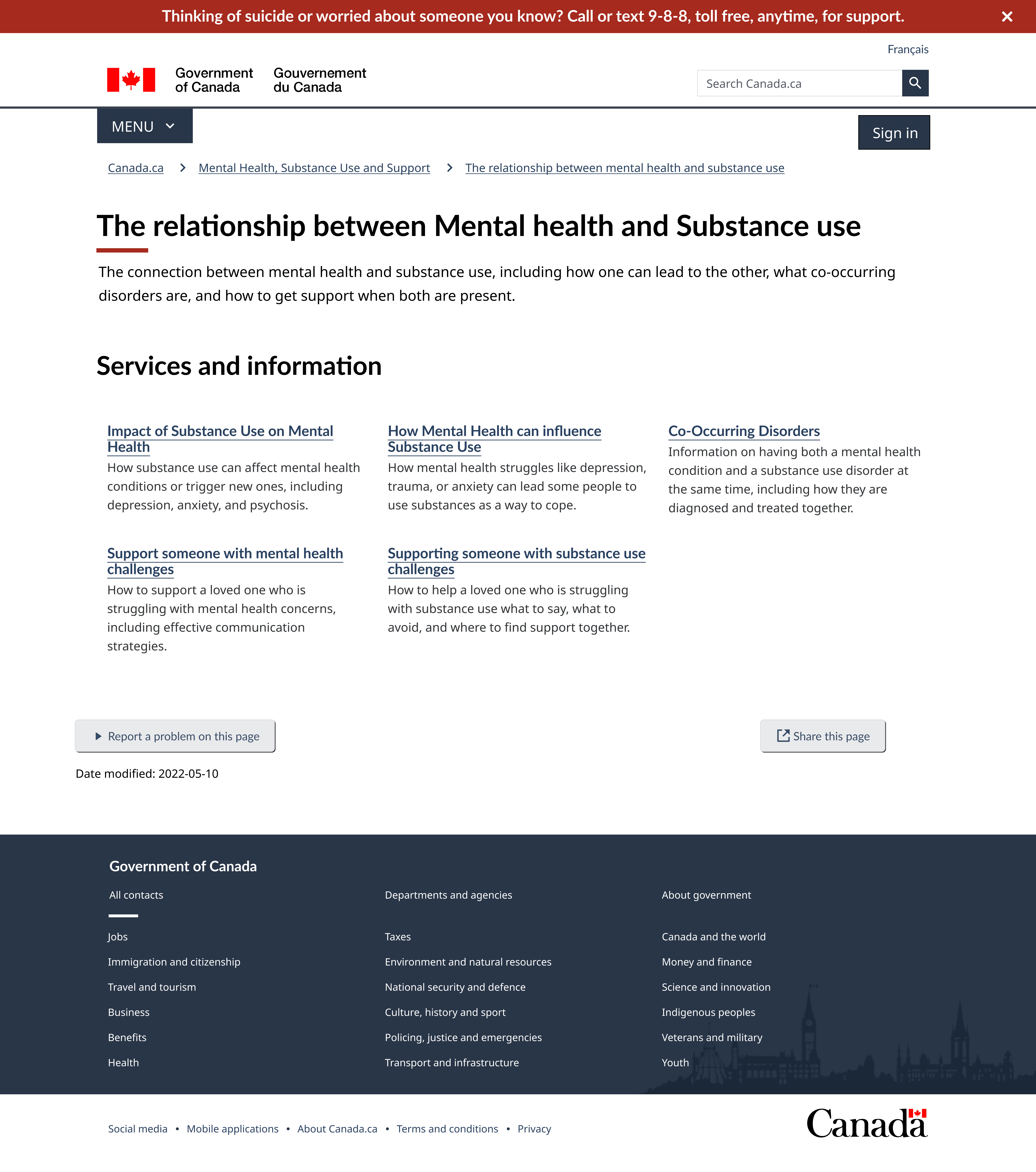
This page didn't exist before. It was the most significant piece of the redesign. Participants kept telling us these two topics felt separate on the site. This section acknowledges the real connection between them and gives it a proper home.
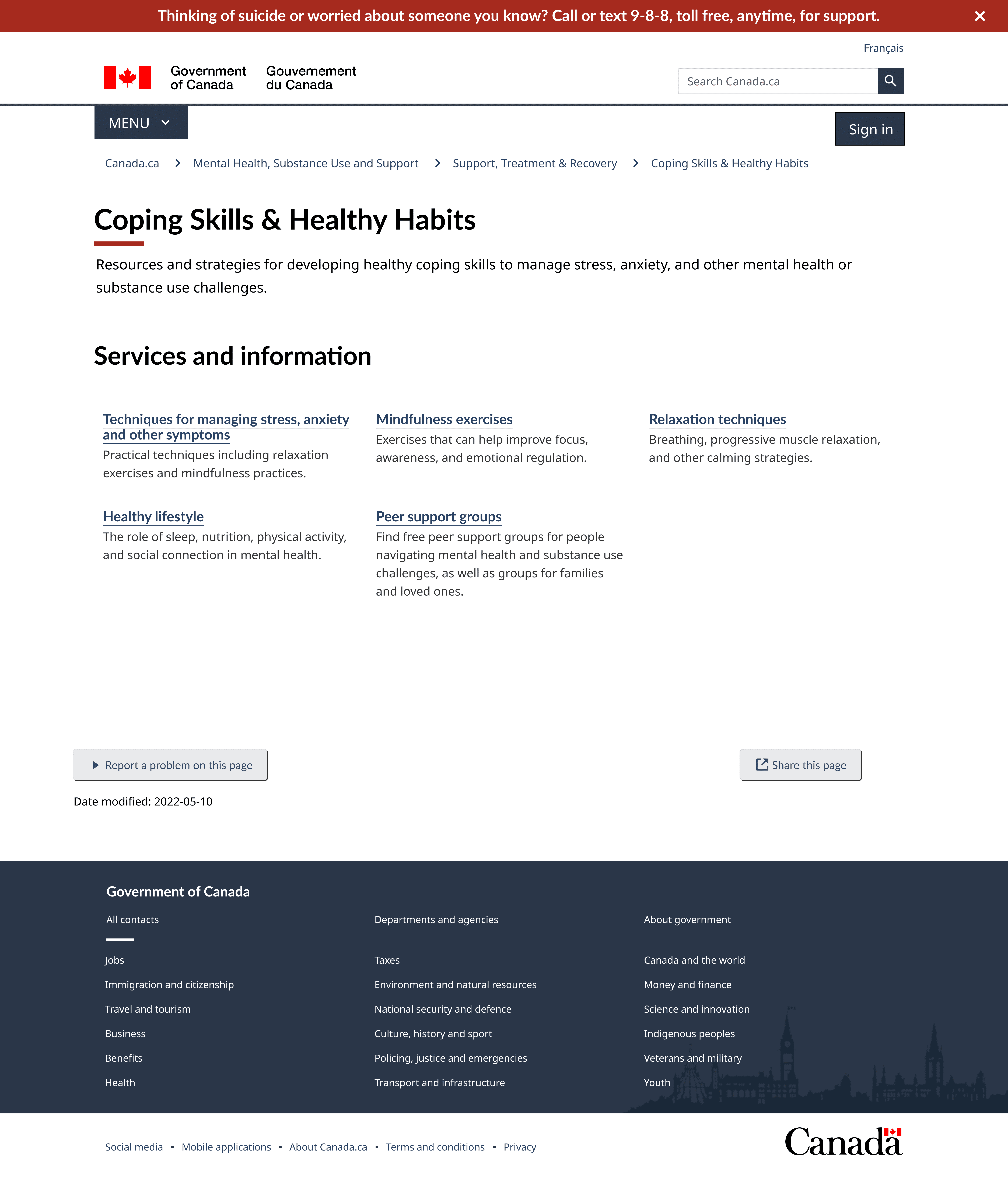
A practical, low-barrier entry point for people who aren't seeking formal treatment or help. Rather than jumping straight to clinical resources, this page meets users where they are… with tools and strategies they can act on right now.
THE RESULTS
PERSONAL REFLECTIONS
I care about mental health… not just as a designer, but as a person who's seen what happens when someone can't find help fast enough. This project was never just a 'job'.
What I didn't expect was how much it would ask of me emotionally. Sitting across someone while they reflect and describe their thoughts about such a sensitive topic… even in the safe setting of a virtual usability session, requires a kind of presence that goes beyond UX skills. I had to show up as a human first, researcher second.
I also learned what it means to lead a team through difficult work. Not just keeping research on track, but making sure the people doing it felt supported. Research on sensitive topics takes a toll, and good leadership means acknowledging that.