PROJECT SUMMARY
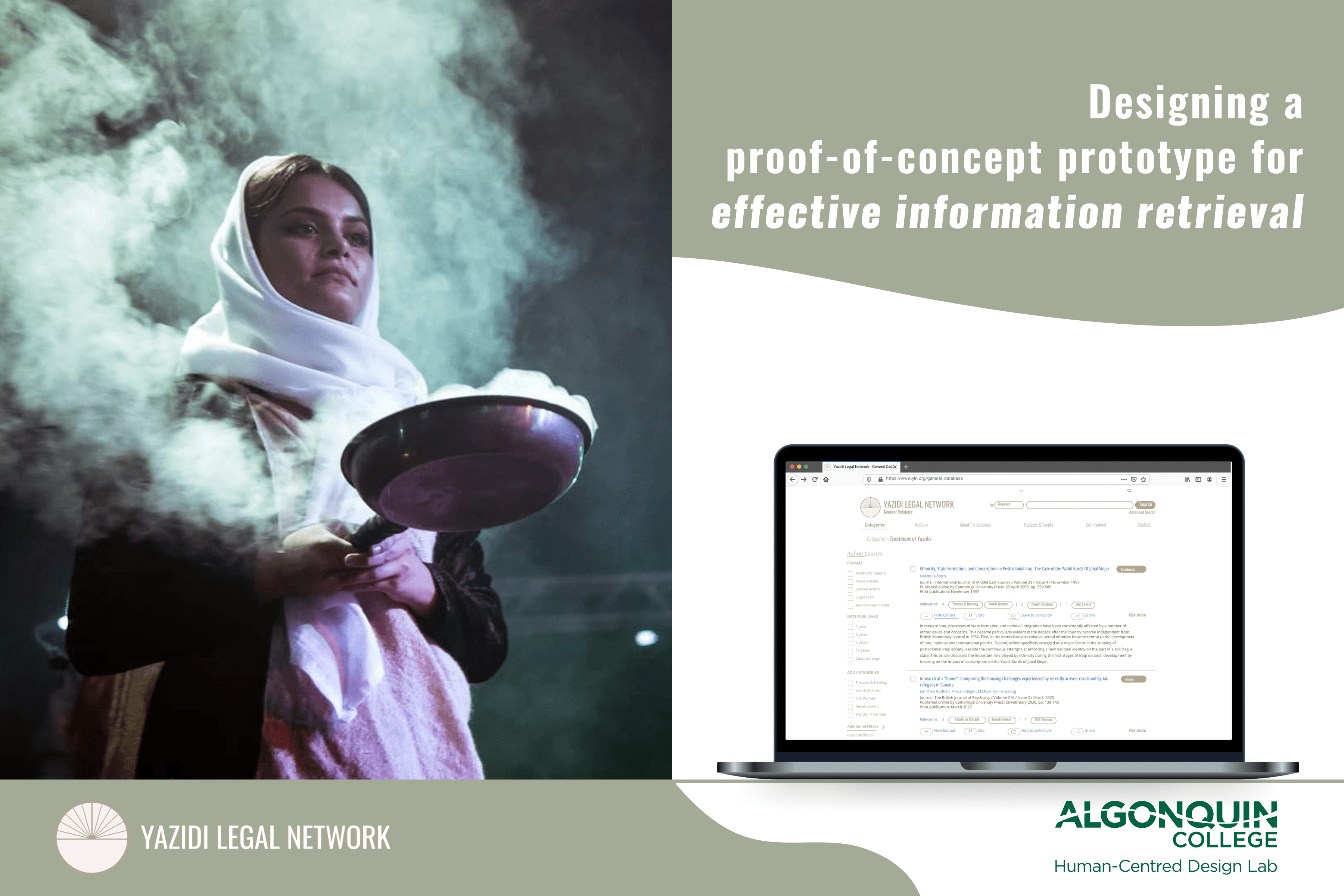
Bringing about justic requires evidence. Evidence requires sources. And for years, the people at Yazidi Legal Network doing this work couldn't effectively find what they needed. Not because the information didn't exist. Because it was locked in a single Google spreadsheet, accessible to a handful of insiders, impossible to search in any meaningful way. The Yazidi Legal Network had built something important. They just had no way to open it to the world. They needed a proof-of-concept compelling enough to walk into a boardroom with and say: this is what it could be, and here's who it serves. That's where I came in.
Client:
Yazidi Legal Network
Timeline:
7 months · 2 phases · 2022
My Role:
UX Designer & Researcher
SCALE OF THE PROJECT
2014
ISIS genocide against the Êzîdî people, recognized by the UN
3
Very different user types in focus
22+
Categories of information locked in a Google Sheet
15
Participants: users and SMEs
METHODOLOGY
01. Lawyer
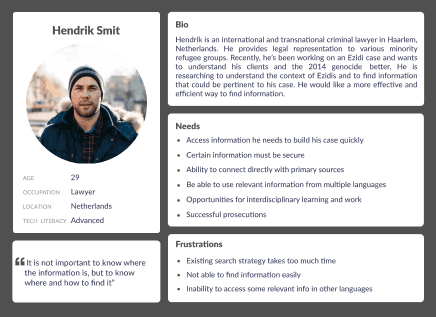
Search means reconstructing an event — linking location, date, perpetrator, and crime type into a chain of evidence. Irrelevant results aren't friction. They're a liability to the case.
"It is not important to know where the information is, but to know where and how to find it."
02. Academic Researcher
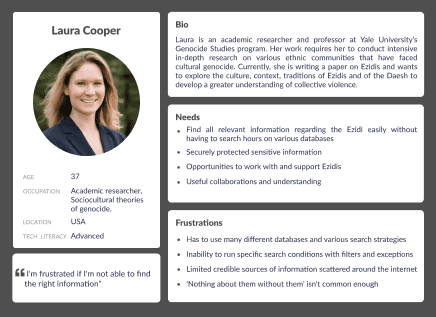
Search means following a thread — tracing how understanding of an event has evolved across sources over time. She needs depth, credibility, and the ability to organise what she finds into her research.
"I'm frustrated if I'm not able to find the right information."
03. Humanitarian
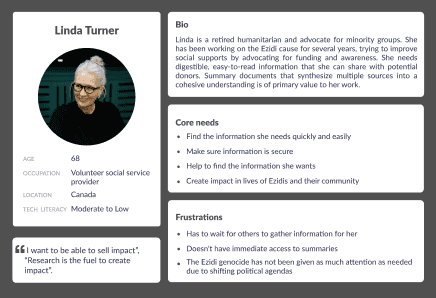
Search means getting the gist, fast. She needs high-level summaries she can walk into a funding meeting with. She doesn't have time to evaluate sources — she needs that work done for her.
"I want to be able to sell impact. Research is the fuel."